Civil wedding in Italy for foreigners: the documents, the steps and the rules by nationality
Two foreigners can marry legally in Italy, and the marriage is normally recognised at home. You need a nulla osta from your own country, translated and stamped documents, two witnesses and a booking with the town hall. Here is how it works, step by step and nationality by nationality.
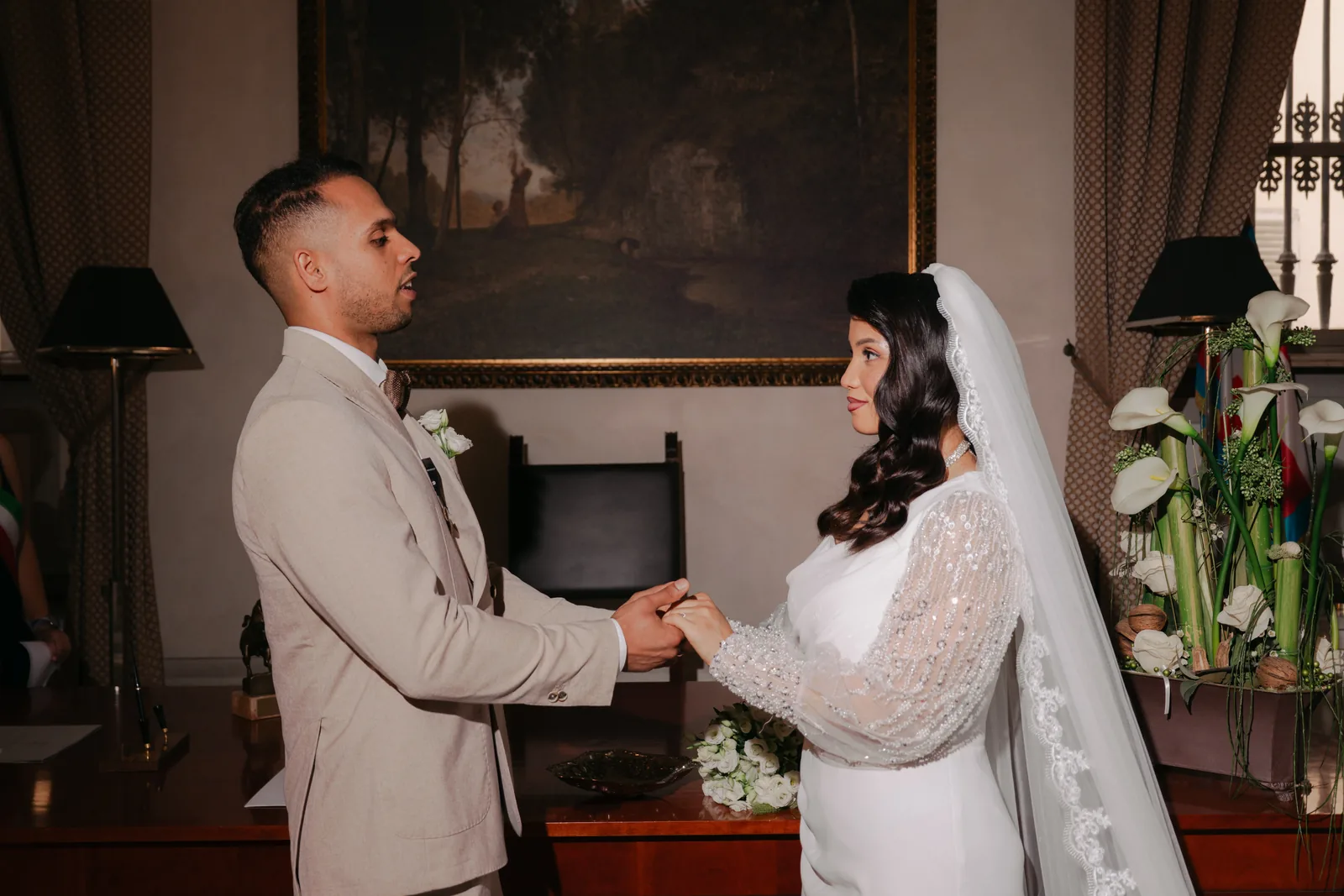
A civil wedding in Italy for foreigners is entirely possible, and far less mysterious than it looks from abroad. If you are wondering how to get legally married in Italy, the short version is this: one document from your own country (the nulla osta), a few stamps and translations, a short appointment at the town hall a few days before, and the ceremony itself. I photograph and film civil ceremonies in Turin and across Italy, and the couples who enjoy the day most are the ones who sorted the paperwork early.
Legal or symbolic: which ceremony do you need?
A civil ceremony is the legal one. A civil status officer marries you in the town hall or another place the comune has officially designated, and the marriage is valid in Italy and normally recognised at home. Turin offers historic rooms such as Palazzo Madama and Teatro Carignano, and the Comune di Como, in calls published in 2023 and 2024, invited owners of historic villas and hotels to host separate civil registry offices. A legal ceremony can only happen where the comune allows it, so ask before you fall for a terrace.
A symbolic ceremony has no legal value. A celebrant leads it, in any language, at any hour your venue allows. Many couples sign the papers at home and keep the day in Italy free of bureaucracy; the UK government describes exactly this option, a legal ceremony in the UK and a commitment ceremony abroad.
My honest view: if the paperwork feels heavy, a symbolic ceremony takes nothing away from the day, and it lets us set the ceremony time around the light instead of the town hall's opening hours.

The documents and steps, in order
1. Choose the comune and ask for its list
Write to the marriage office (ufficio matrimoni or stato civile) of the comune, ask whether your date is free, and ask for its document list for your nationality in writing. Fees vary by comune. In Turin (2026), a ceremony at the town hall is free if one of you lives in the city and costs €352 if neither does; the historic venues cost €2,000 (Palazzo Madama, Accademia delle Scienze, Museo del Risorgimento, Teatro Carignano) or €800 (Sala Marmi at Palazzo Civico), paid in full the month before.
2. The nulla osta (certificate of no impediment)
This is the key document. Under article 116 of the Civil Code, a foreigner marrying in Italy must present a declaration from the competent authority of their own country that, under its laws, nothing prevents the marriage. In English it is a certificate of no impediment, of freedom to marry or of capacity to marry. Depending on your nationality it comes from home, from your consulate in Italy, or both. If either of you was married before, the divorce or death must appear on it or be documented with it.
3. Apostille, legalisation and translation
- Apostille: documents from Hague Apostille Convention countries (the UK, the US, Ireland, Germany, Turkey, Azerbaijan, Russia and Ukraine among them) need an apostille from the issuing country instead of full legalisation.
- EU citizens: birth, marriage and marital status documents issued by one EU country must be accepted in another without an apostille, and you can ask for a multilingual standard form instead of a translation (an office may still, exceptionally, ask for a certified translation).
- Munich Convention countries (Turin lists Austria, Germany, Greece, Luxembourg, Moldova, the Netherlands, Portugal, Spain, Switzerland and Turkey): the multilingual certificate of capacity to marry needs no legalisation.
- Translation: other foreign-language documents need an Italian translation certified by an Italian embassy or consulate, or by an official translator (DPR 445/2000, article 33).
4. Legalisation at the prefettura, where required
A nulla osta issued by a foreign consulate inside Italy usually has to be legalised at the prefettura, the state office in the provincial capital. In Turin this applies unless your country has signed the London convention of 1968 or the Brussels convention of 1987.
5. The declaration of intention to marry
Under article 116 of the Civil Code, only a foreigner who lives in Italy has to have banns published, so when neither of you is Italian or lives in Italy there are normally none. You bring your documents to the comune and, at an appointment shortly before the wedding, declare your intention to marry before the civil status officer, with your witnesses and interpreter. The Italian Consulate in San Francisco describes this as two or three days after the documents are handed in. If one of you lives in Italy, banns apply: in Turin they are displayed for 8 days plus 3, and the wedding can take place from the twelfth day and within 180 days.
6. Interpreter and witnesses
If either of you, or either witness, does not understand Italian, an interpreter must be present; in Turin you nominate the interpreter yourselves when you file the papers. You also need two adult witnesses with valid identity documents, and the Civil Code allows them to be relatives.
7. The ceremony and afterwards
The officer reads articles 143, 144 and 147 of the Civil Code, receives your consent, and the record is drawn up immediately. Ask for multilingual extracts of the marriage certificate (estratto plurilingue). Some countries then want the marriage registered with their embassy, and any change of surname is handled at home.

Rules by nationality
United Kingdom
GOV.UK says a UK certificate of no impediment (CNI) is equivalent to the Italian nulla osta and is accepted for six months. If you live in the UK, give notice at a UK register office and say the CNI is for a marriage abroad; the names must match your passports. The CNI then needs an apostille and an Italian translation, and you also sign a bilingual statutory declaration before a UK notary public, which is apostilled too. A "no trace" letter is not accepted, and Turin's list for British citizens asks for exactly this pair. The British Embassy in Rome route is for British nationals who live in Italy or arrive without a UK CNI: you sign a notice and affirmation before an Italian notary, after three whole days in Italy if you do not live there, apply online and post them to the Embassy, which displays the notice for 7 days. Ask your comune which documents it wants before you apply; my guide for UK couples has the fees and timings.
United States
The Italian Consulate General in San Francisco describes an atto notorio sworn before an Italian consul with two witnesses per American partner, valid for 90 days, then a dichiarazione giurata (sworn statement) at a US Embassy or Consulate in Italy. The US Embassy in Italy (2026) adds that the atto notorio witnesses must be over 18 and cannot be relatives, and that legalising the dichiarazione at the Prefettura needs a €16 revenue stamp. Turin's sheet says the atto notorio can also be made in Italy before the Tribunale di Torino or a notary, but asks for four witnesses, so confirm the number with your comune. You also need a birth certificate with apostille and translation if the comune asks, and proof that any previous marriage ended.
Ireland
The Department of Foreign Affairs issues the Certificate of Freedom to Marry, also known as the Nulla Osta. Apply at least four months before the wedding; your witnessed statutory declarations cannot be dated more than six months before it. The fee is €66 per Irish applicant (€60 plus €6 postage, 2026), plus a €60 late fee if you apply less than 28 days before the date. Ireland recognises the marriage if it is entered on the Italian civil register and all legal formalities were followed.
Germany
The latest guidance from the German Federal Office for Foreign Affairs (dated July 2022; confirm it with your Standesamt): Germans who do not live in Italy can marry at any Italian registry office, with no minimum stay and no banns. You need an Ehefähigkeitszeugnis from the Standesamt of your last German residence (Standesamt I in Berlin if you never lived in Germany), on the international form and valid for six months, an international birth certificate, and a passport or ID valid for at least six months. An interpreter must be present.
Turkey
As a Munich Convention country, Turkey's multilingual certificate needs no legalisation. The Turkish Consulate General in Milan issues the evlenme ehliyet belgesi free of charge: you apply in person after booking an appointment, and the couple signs the application form. After the wedding, register the marriage with the consulate (Milan accepts this by post) so it reaches the population records.
Azerbaijan
The Embassy of Azerbaijan in Rome issues a certificate of celibacy (the nulla osta) to citizens who do not currently live in Azerbaijan: an application form, a copy of a valid passport or ID card, and a state fee of 10 USD. Under Turin's general rule, a certificate from a consulate in Italy is then legalised at the Prefettura. If you live in Azerbaijan, ask the embassy which document applies.
Russia and Ukraine
I could not open an official Russian or Ukrainian consular page on marriage in Italy, so here is only the general Italian rule. A nulla osta issued by your consulate in Italy must be legalised at the prefettura unless an exemption applies, and home documents need an apostille and a sworn Italian translation. Confirm the exact documents and fees with your consulate and your comune before you book anything.

Religious ceremonies
Catholic. Under the 1984 agreement between Italy and the Holy See, a church wedding can be a concordat marriage: once the record is transcribed into the civil register, after civil publications, it is legally valid too. Foreign couples still need a nulla osta, plus parish documents (recent baptism certificates, a pre-nuptial enquiry, permission to marry outside your parish) sent through your bishop. The Italian Bishops' Conference expects preparation of normally not less than three months, and some dioceses restrict dates: Rome allows no weddings during Lent.
Other faiths. Italy has agreements (intese) with fourteen denominations (the fourteenth, with the Romanian Orthodox Diocese of Italy, was approved by law in July 2026), including the Waldensian Church, the Jewish communities, the Orthodox Archdiocese and the Church of England association. In Turin, publications for a non-Catholic wedding need a request to authorise the minister, or just the couple's request for denominations with an intesa; publications come first whatever the rite. No Islamic community has an intesa, so a nikah alone usually has no civil effect; couples who want a legal marriage add a civil ceremony (see nikah in Italy).
Same-sex couples: the unione civile
Italy offers same-sex couples the civil union (unione civile, Law 76/2016) rather than marriage. Two adults of the same sex form it by a declaration before the civil status officer, with two witnesses. In Turin, foreign citizens bring a nulla osta for the civil union from their consulate in Italy, or equivalent documentation; the fixed fee is €16, plus €352 if neither partner lives in Turin, and the record is signed within 40 days of the request (2026). Check how your home country recognises an Italian civil union.
Timeline checklist
- 9 to 12 months before: choose legal or symbolic and the comune; ask about dates and fees; book the venue, then your photographer and filmmaker.
- 6 months before: get the comune's document list in writing; check passports (some offices want six months' validity); order fresh birth certificates and apostilles.
- 4 months before: apply for your nulla osta (UK citizens living in the UK: give notice at your register office; Irish citizens: at least four months ahead); book a sworn translator and an interpreter.
- 2 to 3 months before: send copies to the comune for checking; make sure each document will still be valid on the day (six months for the German certificate, 90 days for the American atto notorio).
- The week before: arrive in Italy, legalise consular documents at the prefettura, make the declaration with your witnesses and interpreter.
- After the wedding: collect multilingual extracts and register the marriage at home if your country asks.
FAQ
Can two foreigners get legally married in Italy?
Yes. Two foreigners can marry at an Italian comune without living in Italy. Each of you needs a nulla osta from your own country, supporting documents with apostille and translation, two witnesses and an interpreter if you do not speak Italian. The marriage is normally recognised at home, provided it was lawful in Italy and your country's own conditions are met.
What is a nulla osta?
It is the declaration, required by article 116 of the Italian Civil Code, that the law of your own country allows you to marry: in English, a certificate of no impediment or of freedom to marry. Depending on your nationality it is issued at home, by your consulate in Italy, or partly by both. Some countries use a multilingual certificate of capacity to marry instead.
How long do we need to be in Italy before the wedding?
There is no general minimum stay for foreign couples, but you must be there for the declaration of intent, usually a few working days before the ceremony. Some routes add their own rule: on the British Embassy route, for British nationals without a UK certificate, you need three whole days in Italy before the notary appointment, then 7 days while the notice is displayed. Plan to arrive about a week before, more on that route.
Do we need an interpreter?
Yes, if either of you or either witness does not understand Italian. The interpreter translates the declaration, the reading of the law and your consent. In Turin you nominate the interpreter yourselves when you present the documents. Ask your comune whether it requires a professional or accepts a bilingual friend.
Can our witnesses be family members?
Yes. Italian law asks for two witnesses at a civil ceremony and allows them to be relatives. They must be adults and bring a valid identity document. If a witness does not understand Italian, the interpreter must cover them too. Friends travelling with you can be witnesses; you do not need Italian residents.
How much does a civil wedding in Italy cost?
The town hall part is often modest. In Turin (2026) a civil ceremony costs nothing if one of you lives in the city and €352 if neither does, and the historic rooms cost €800 or €2,000. Add apostilles, sworn translations, the interpreter and your consular fees, which vary by country. Ask your comune for its current fees in writing.
Is a church wedding in Italy legally valid?
A Catholic concordat marriage is: once the record is transcribed into the civil register, it has the same legal effect as a civil marriage. Foreign couples still need the civil documents, including a nulla osta. Some other faiths can also celebrate marriages with civil effect; ask the comune and your minister early. Otherwise, you need a separate civil ceremony.
Can we marry legally in a villa or on a beach?
Only where the comune has designated the place for civil ceremonies. Some comuni use historic rooms, gardens or villas, and Como, in calls from 2023 and 2024, invited historic villas and hotels to host separate civil registry offices. A beach or private garden is usually not possible for the legal part, which is why many couples hold a symbolic ceremony there.
Your day, without the stress
I work with planners and celebrants, speak English, Italian, Russian, Turkish and Azerbaijani with families on the day, and plan the timeline around your ceremony slot and the evening light (the best time to get married in Italy has the sunset times). See my wedding work, Mohammed and Hejrat's day, or my free planning guide. When you are ready, send me your date and venue through the contact page.
Sources
- Civil Code arts. 107 and 116, via Brocardi: art. 107, art. 116
- Comune di Torino: publications and foreign citizens, special cases by nationality, July 2026, civil ceremony, interpreter, fees, historic venues, civil union
- Comune di Como, separate civil registry offices: notice (Giunta resolution 210/2023, reissued October 2024)
- DPR 445/2000, article 33, translation of foreign documents: normattiva.it
- Law 76/2016 on civil unions: normattiva.it
- Law 121/1985, Italy and Holy See agreement: text
- Presidency of the Council of Ministers, intese with religious denominations, including Law 126/2026: list
- Italian Bishops' Conference, 1990 decree on marriage: PDF
- Pontifical Irish College, Rome: weddings
- HCCH, Apostille Convention status table: hcch.net
- EU, public documents: Your Europe, e-Justice, Italy
- UK government: CNI for Italy if you live in the UK, CNI by post through the Embassy, nulla osta application pack (updated August 2024), marriages abroad
- Ireland, Department of Foreign Affairs: marriage abroad
- Consulate General of Italy, San Francisco: non-EU citizens marrying in Italy
- US Embassy and Consulates in Italy: getting married in Italy (2026)
- German Federal Office for Foreign Affairs: Deutsche heiraten in Italien (Stand July 2022, the latest version in October 2026)
- Turkish Consulate General, Milan: consular procedures and evlenme ehliyet belgesi information note
- Embassy of Azerbaijan, Rome: certificate of celibacy
Keep reading
 Planning guideNikah in Italy: a practical guide to a Muslim wedding in ItalyYou can hold a nikah in Italy, and many couples do, but on its own it does not make you married under Italian law. Here is how couples usually combine a civil ceremony, the nikah and the celebration, and what to ask venues about halal food, prayer space and privacy.
 Planning guideThe best time to get married in Italy: weather, crowds and light, month by monthFor most couples, the best time to get married in Italy is late May, June or September: warm days, long evenings and softer light than in the heat of July and August. Below is every month from April to October, with climate averages, events and sunset times, so you can choose with your eyes open.