Getting married in Italy as a Russian citizen: documents and visas
Yes, Russian citizens can marry legally in Italy, and Russia recognises the marriage. You need a nulla osta from the Russian consulate in Italy, Schengen visas and time for the paperwork. Here it is step by step, from official sources only, with honest flags where the rules need confirming.
Can Russian citizens get married in Italy? Yes: Italian law lets any foreigner marry at a town hall (comune) with a document from their own country showing that nothing prevents the marriage. Getting married in Italy from Russia in 2026 is entirely possible, but it takes more preparation than for EU couples: visas, a certificate from the Russian consulate in Italy, and rules that have changed in recent years. We are the Toghrul Nabi team, wedding photographers and filmmakers in Turin, and we speak Russian. This is what the official sources say, flagged wherever something needs confirming.
Can Russian citizens get married in Italy?
Yes. Article 116 of the Italian Civil Code asks one thing of a foreigner: a declaration from their own country's competent authority that, under its laws, nothing prevents the marriage. That is the nulla osta. Two Russians can marry this way, as can a Russian and an Italian, or a couple with two different passports.
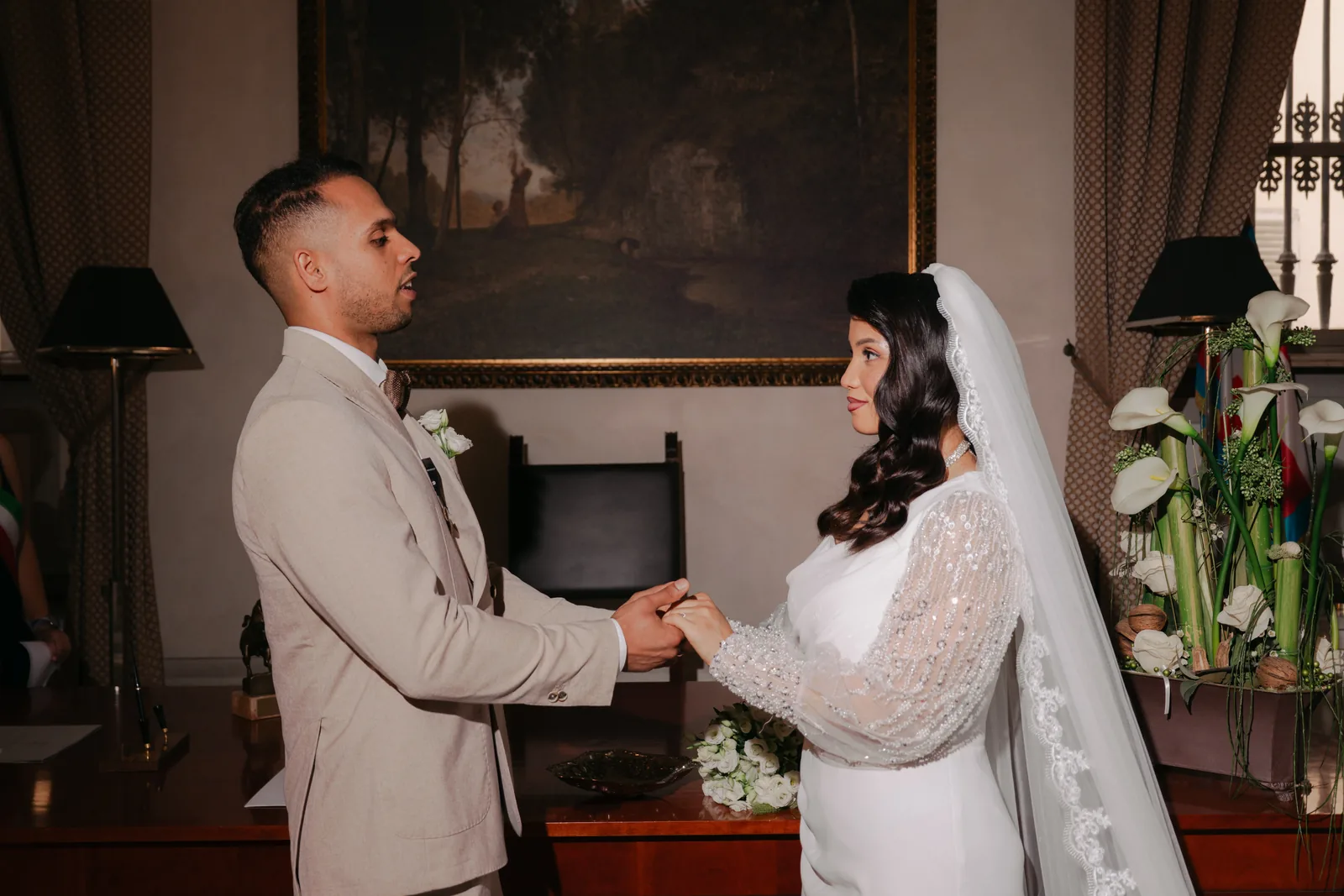
A civil ceremony at the comune is a legal marriage. A civil status officer conducts it in front of two witnesses, in a town hall room or another place the comune has designated. In Turin that means two town hall rooms and five historic venues on Saturdays; see our guide to a civil wedding in Turin.
Russia recognises it. Article 158 of the Russian Family Code says that marriages of Russian citizens concluded abroad under the laws of that country are valid in Russia, unless an impediment under article 14 applies (another registered marriage, for example). You do not register the marriage again in Russia, but there is a duty to report it; more on that below.
Marrying at the Russian consulate in Italy is usually not an option: the Russian Ministry of Foreign Affairs states that consulates register marriages of Russian citizens who live outside Russia. For couples who live in Russia, the route is the Italian comune.
The documents for a Russian citizen, step by step
The general route for every foreigner is in our guide to a civil wedding in Italy for foreigners; here is only what concerns Russian citizens.
1. The comune's document list
Write to the marriage office (ufficio matrimoni) of the comune where you want to marry, ask whether your date is free, and ask for its document list for a Russian citizen in writing. Every comune applies the rules in its own way, and it has the last word.
As an example, the Comune di Torino asks non-EU citizens for a nulla osta from their consulate or embassy in Italy, plus a passport. The nulla osta must show surname and first name, place and date of birth, father's and mother's names, residence, citizenship and marital status and, after a divorce or a spouse's death, the previous spouse's name and the dates and places of that marriage and of its end.
2. The certificate of no marriage from a Russian registry office
Under Russia's law on civil status records (article 9, point 2.1), an unmarried person can get from a ZAGS (civil registry office) a document confirming that no marriage is registered for them. Any ZAGS issues it (the same day, in person), and it can be requested through the Gosuslugi portal. The Russian Consulate General in Geneva, for example, states that it can only be obtained in Russia, in person or through a representative with a notarised power of attorney, or requested from Russia through a consulate, which takes time.
Whether the Russian consulate in Italy needs it for the nulla osta, how recent it must be and what else to bring, we could not check on an official page. Ask the consulate while you are still in Russia.
3. The nulla osta from the Russian consulate in Italy
The certificate "of no impediment to marriage" (Nulla Osta al Matrimonio) is issued by Russia's consular offices in Italy: the consular section of the embassy in Rome and the consulates general in Milan, Genoa and Palermo. Appointments are booked through the Russian MFA's online system (kdmid.ru), and the Rome booking page is explicit: an appointment does not guarantee the service, you must bring the full set of documents, and the consular section accepts payment in cash only.
In practice: a visit to the consulate in Italy, by appointment, before your appointment at the comune. Ask in advance which consulate covers your region, how long the certificate takes and what it costs. If your name is spelled differently in Latin letters across your documents, ask about the "same person" certificate (Stessa Persona Fisica) too.
4. Legalisation at the prefettura: possibly not needed
A certificate from a foreign consulate in Italy is usually legalised at the prefettura. But the Comune di Torino writes that no legalisation is needed for countries party to the London convention of 1968, and the Italian prefetture's data sheet (June 2024, from the Council of Europe's database) lists Russia among its parties; the Council of Europe treaties Russia terminated in 2023 do not include it. Other comuni may read this differently, so ask yours in writing whether it accepts the Russian consulate's nulla osta without legalisation.
5. Apostille and translation of Russian documents
If the comune asks for Russian documents directly (a birth or divorce certificate, for example), they need an apostille and an Italian translation: Italy and Russia are both parties to the 1961 Hague Convention.
- Apostille: on civil status documents it is issued by the ZAGS authority of your Russian region (article 13 of the law on civil status records). The Italian Consulate General in Moscow does not apostille Russian documents.
- Translation: made after the apostille, and the apostille itself must be translated in full. The Italian consulate in Moscow certifies translations by translators accredited with it: €13 per sheet into Italian (2026 fees), by appointment through Prenot@Mi. It does not accept notarised translations for certification.
- Documents for the Russian consulate in Italy remain Russian documents for a Russian authority; ask the consulate what it needs (step 3).
6. At the comune: the declaration, witnesses and interpreter
If neither of you lives in Italy or is an Italian citizen, article 116 means no banns (pubblicazioni). The comune sets an appointment where you confirm your intention to marry, with your witnesses and interpreter; ask how many days before the wedding. If one of you lives in Italy, banns are required and take longer: in Turin you can marry from the twelfth day after they go up.
You need two witnesses with valid identity documents; the Civil Code allows them to be relatives. If either of you or either witness does not understand Italian, an interpreter must be present at the ceremony, and in Turin the couple nominates them. Your photographer cannot be your interpreter: those are two separate jobs at the same minute.
7. After the wedding: apostille, translation and notice to a ZAGS
Ask the comune for an extract of the marriage record (estratto di matrimonio), ideally multilingual. To work in Russia it needs an apostille, issued in Italy by the competent Italian authority (not the Italian consulate in Moscow), and a Russian translation. Russia's law on civil status records (article 13) recognises foreign marriage documents once legalised, unless a treaty provides otherwise; between Italy and Russia, the apostille plays that role.
One more duty few couples know about: under article 13.1 of the same law, a Russian citizen whose marriage was registered abroad sends the details to the ZAGS where they live, or to a Russian consulate abroad, no later than one month after the registration.
Visas for Russian citizens in 2026
Where to apply. According to the Italian Consulate General in Moscow, residents of Moscow and its region (by the registration stamp in their internal passport) apply at the VMS visa centre in Moscow, and the rest of the Moscow consular district at Almaviva Russia (Yekaterinburg, Kazan, Krasnodar, Moscow, Nizhny Novgorod, Rostov-on-Don, Novosibirsk, Samara). St Petersburg and the north-west belong to the Italian Consulate General in St Petersburg. The consulate warns that processing may take longer than expected and asks applicants to apply well ahead.
What has changed. Since September 2022 the EU-Russia visa facilitation agreement has been fully suspended, so the general Visa Code rules apply: a fee of €90 for adults and €45 for children aged 6 to 12 (since 11 June 2024), and a decision within 15 days, extendable to 45. Under a European Commission decision of 6 November 2025, Russians who live in Russia and apply there get multiple-entry visas only if they are close relatives of EU citizens or of Russians legally resident in the EU (one year, after three visas lawfully used in the previous two years) or transport workers; member states may still make exceptions in justified cases. For everyone else it means a single-entry visa for each trip: a planning visit and the wedding itself will probably need two visas.
Documents for a tourist visa. The Moscow consulate's list (July 2026): form, passport valid at least three months beyond the stay, photo, proof of means, flight and accommodation bookings, medical insurance of at least €30,000, proof of employment, three months of bank statements, fee receipt, and a copy of the internal passport (personal data and registration pages). It may ask for more.
Passports. On the European Commission's list of 2 October 2026, Italy recognises ordinary Russian passports without reservation. Several Schengen countries no longer recognise non-biometric ones, though: Germany, France, Poland, Czechia, Denmark, the Baltic states, Romania, Iceland, Finland (from 1 June 2026), the Benelux countries and Sweden (from 1 October 2026), some with exceptions, for children for example, and transition rules. If your route enters Schengen through one of them, travel on a biometric passport. Russian passports issued in Crimea and Sevastopol, in the Donetsk, Luhansk, Kherson, Zaporizhzhia and Kharkiv regions, in Abkhazia and South Ossetia, or to residents of those territories, are not recognised either (from the dates in EU decision 2023/1061).
Flights and the border. There are no direct flights: since 28 February 2022 Russian airlines have been barred from EU airspace, so travellers fly via third countries. At the first Schengen border, the Entry/Exit System (EES) has been fully operational since April 2026: visa holders give fingerprints and a photo. Visa holders do not need ETIAS.
Every guest from Russia needs their own visa, so tell them early.
A symbolic wedding: sign at home, celebrate in Italy
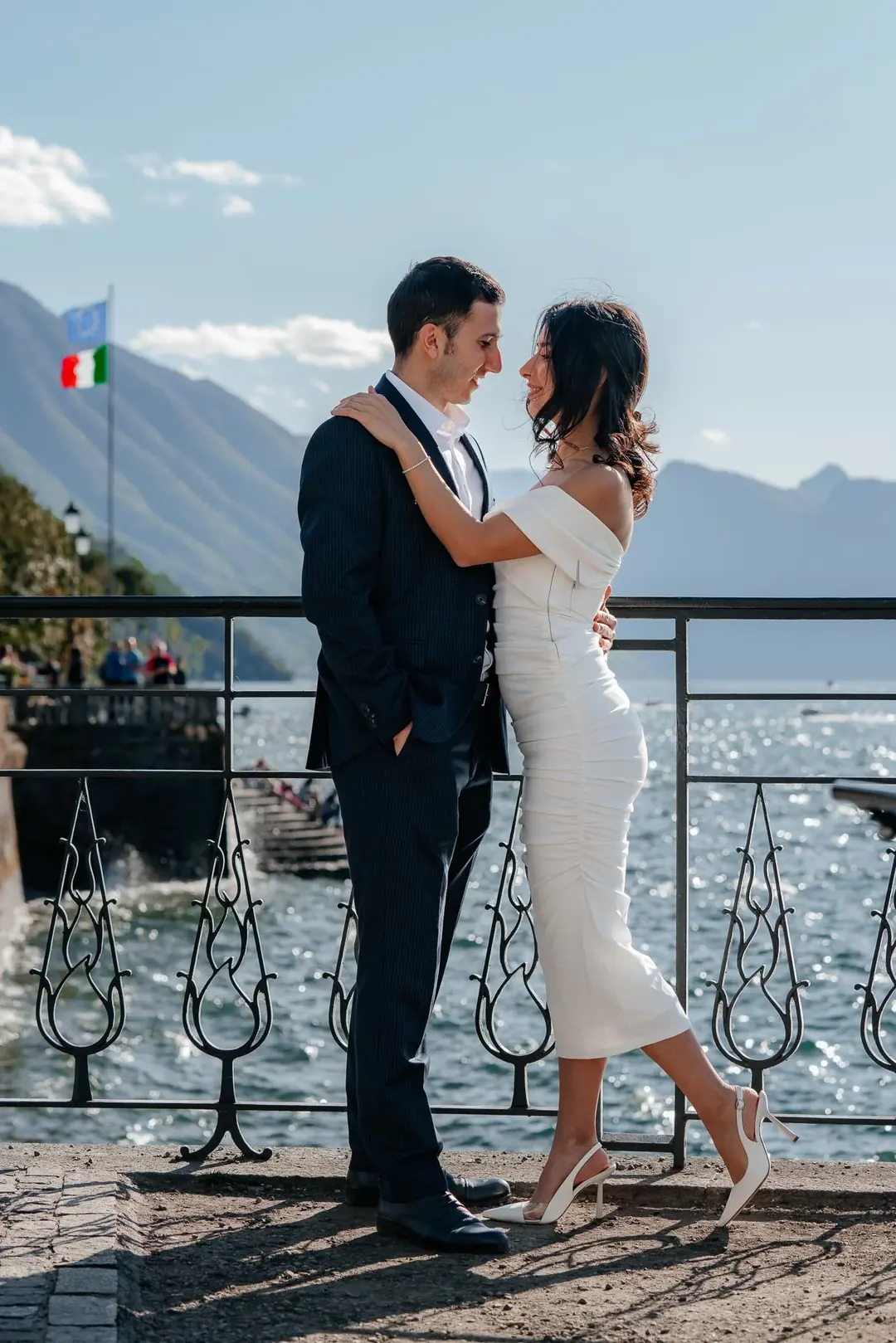
Many couples register at a ZAGS in Russia and hold a symbolic ceremony in Italy. It has no legal force, but there is no paperwork and no town hall timetable, and it can be in Russian, on a villa terrace or by a lake, wherever the venue allows. Under article 11 of the Family Code, a ZAGS registers the marriage once a month has passed since the application (sooner for valid reasons), so it is easy to fit in before you travel.
Our honest view as photographers and filmmakers: a symbolic ceremony takes nothing away from the day. We can set its time by the light instead of the town hall's hours, and we like that a lot.
Where to marry: Turin, the lakes, Piedmont
- Turin. Five historic town hall venues on Saturdays, from Palazzo Madama to the stage of the Teatro Carignano: see our guide to a civil wedding in Turin.
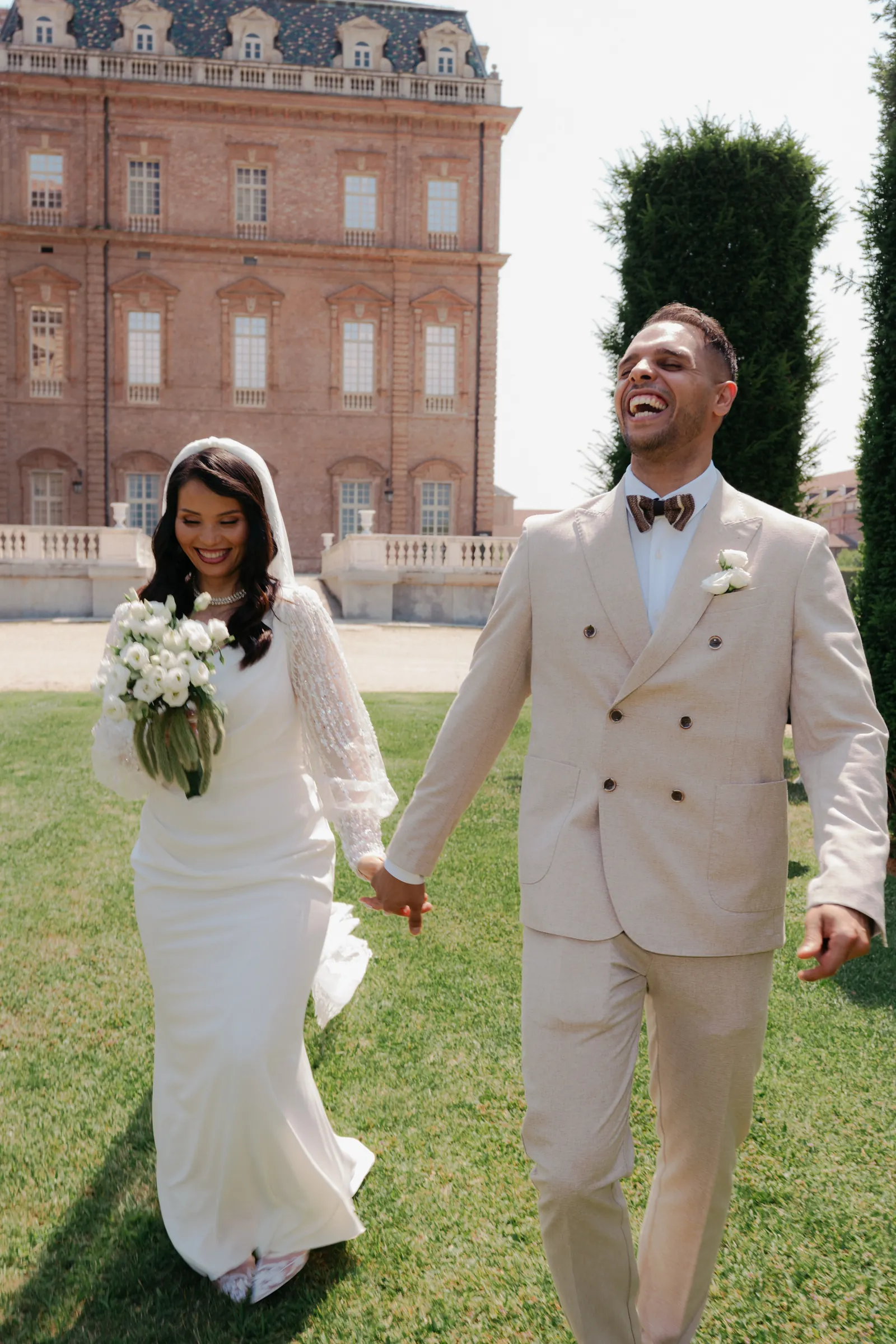
- Near Turin. Mohammed and Hejrat married at the town hall in July 2026, then spent the day at the Reggia di Venaria; here is their story, with photos and film.
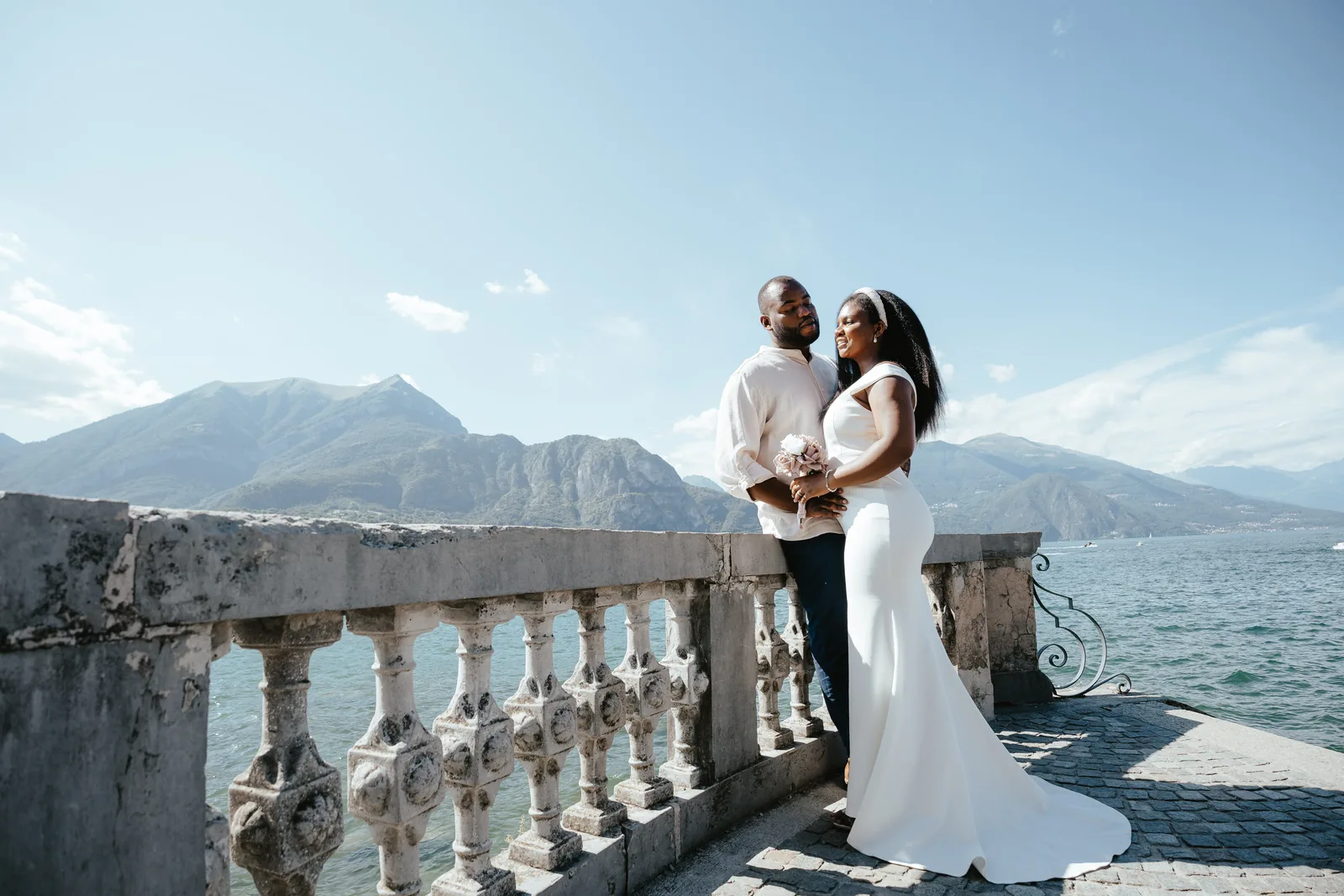
- Lake Como. Where a legal ceremony is possible on the lake, and where only a symbolic one: our page about weddings on Lake Como.
When you choose the month, look at our guide to seasons and sunsets, and leave plenty of time for the visas.
A checklist for couples from Russia
- 9 to 15 months before: legal or symbolic; region and comune; the comune's document list in writing; venue, then photographer.
- 6 months before: check passports (biometric, validity) for you and your guests; ask the Russian consulate in Italy what the nulla osta needs.
- 4 to 5 months before: ZAGS certificates, apostilles if the comune wants Russian documents, an interpreter.
- 3 months before, at the latest: visas for you and your guests.
- 2 months before: copies to the comune for checking; an appointment at the Russian consulate in Italy.
- In Italy, before the wedding: the consulate, the prefettura if needed, the declaration at the comune.
- After the wedding: a multilingual extract, an apostille in Italy, a Russian translation, notice to a ZAGS or consulate within a month.
How we work with Russian-speaking couples
We speak Russian, Italian, English, Turkish and Azerbaijani: we discuss everything with you in your language, handle the venue and the comune in Italian, and your parents can talk to us easily on the day.
Our team takes the photos and shoots the film on one timeline. Our style is a mix of documentary and guided: a calm, discreet presence on the day, with portraits we guide you through and real moments left to happen. Every collection includes a consultation before the wedding: the timeline around your ceremony and the light, photo spots, a rain plan, and close work with your planner if you have one.
You send your date and venue, we reply within a day or two, and a free 20-minute video call can follow, in Russian. We send our collections and prices once we know your date and venue, with travel and accommodation added openly. For a May to September Saturday, book 9 to 15 months ahead. Our free guide to getting married in Italy helps you plan step by step.
FAQ
Can Russian citizens get married in Italy in 2026?
Yes. Italian law lets any foreigner marry with a document from their own country showing no impediment, the nulla osta, which for Russian citizens comes from the Russian consulate in Italy. You also need Schengen visas, two witnesses and an interpreter if you do not speak Italian. Ask the comune for its document list in writing.
Is an Italian marriage recognised in Russia?
Yes. Under article 158 of the Russian Family Code, a marriage concluded abroad under that country's laws is valid in Russia unless an impediment under article 14 applies. For Russian authorities, the Italian certificate needs an apostille issued in Italy and a Russian translation. You must also notify a ZAGS or consulate within one month.
Where does a Russian citizen get a nulla osta for marrying in Italy?
At a Russian consular office in Italy: the consular section of the embassy in Rome or the consulates general in Milan, Genoa and Palermo, by appointment through the kdmid.ru system. Ask the consulate in advance which documents to bring from Russia: the ZAGS certificate of no marriage is easiest to get while you are still at home.
Do Russian documents need an apostille?
Russian documents you hand to Italian authorities do: Italy and Russia are both parties to the Hague Convention. The regional ZAGS authority apostilles civil status documents, then they are translated into Italian, apostille included. In Turin, a nulla osta from the Russian consulate in Italy is exempt from legalisation under the London convention; check with other comuni.
Does Italy issue Schengen visas to Russian citizens?
Yes, Italy still accepts applications through visa centres in Russia. But since November 2025 most Russians living in Russia get single-entry visas, the fee is €90 and a decision takes 15 to 45 days, and the consulate warns of possible delays. Apply as early as you can, especially if many guests are coming.
Can we marry at the Russian consulate in Italy?
Usually not. The Russian Ministry of Foreign Affairs states that consulates register marriages of Russian citizens who live outside Russia. If you live in Russia, you can marry either at an Italian comune or at a ZAGS at home, and then hold a symbolic ceremony in Italy.
Planning a wedding in Italy from Russia?
The documents and visas start with the comune and the consulate; the day itself, the light and the film are where we come in. Send us your date and venue, even if you only have a region and a month so far, and we will reply in Russian or English.
Sources
- Italian Civil Code, arts. 107 and 116 (via Brocardi): art. 107, art. 116: «Lo straniero che vuole contrarre matrimonio nello Stato deve presentare all'ufficiale dello stato civile una dichiarazione dell'autorità competente del proprio paese, dalla quale risulti che giusta le leggi a cui è sottoposto nulla osta al matrimonio»
- Russian Family Code, arts. 157 and 158, on the Kremlin's site: kremlin.ru; art. 158(1): «признаются действительными в Российской Федерации, если отсутствуют предусмотренные статьей 14 настоящего Кодекса обстоятельства, препятствующие заключению брака»
- Federal Law No. 143-FZ on civil status records (arts. 9, 13, 13.1), current text on the Russian MFA's site: kdmid.ru (DOCX); art. 13.1(4): «не позднее чем через месяц со дня совершения компетентным органом иностранного государства регистрации акта гражданского состояния»
- Russian MFA Consular Department: civil status registration, frequently asked questions
- Russian MFA appointment system: consular section of the embassy in Rome, Consulate General in Milan, Genoa, Palermo: certificates «Об отсутствии препятствий для вступления в брак» (Nulla Osta al Matrimonio) and «Одно и то же лицо»
- Russian Consulate General in Geneva, certificate of capacity to marry (an example of another consulate's practice)
- Gosuslugi: certificate of no registered marriage
- Comune di Torino: banns and documents for foreign citizens, civil ceremony and interpreter
- Italian Ministry of the Interior, prefetture: London convention of 1968, parties (PDF, June 2024); Russian Federal Law No. 43-FZ of 28 February 2023, list of terminated Council of Europe treaties
- Italian Consulate General in Moscow: translation and legalisation of documents, where to apply for a visa, tourist visa document list (PDF, July 2026)
- Italian Ministry of Foreign Affairs: terms for issuing visas
- European Commission: decision C(2025) 7552 on multiple-entry visas for Russian nationals (6 November 2025), 2022 guidelines on visas for Russian applicants (PDF), Schengen visa fee from 11 June 2024
- European Commission: travel documents issued by third countries, part I (updated 2 October 2026)
- European Commission: EES and ETIAS, 28 April 2026
- Council Regulation (EU) 2022/334, ban on Russian air carriers: EUR-Lex
- HCCH, Apostille Convention status table: hcch.net
Keep reading
 Planning guideCivil wedding in Italy for foreigners: the documents, the steps and the rules by nationalityTwo foreigners can marry legally in Italy, and the marriage is normally recognised at home. You need a nulla osta from your own country, translated and stamped documents, two witnesses and a booking with the town hall. Here is how it works, step by step and nationality by nationality.
 Lake ComoWedding photographer on Lake Como: towns, ceremonies, boats and lightOur team photographs and films weddings, elopements and engagements on Lake Como. Here is what couples ask us first: which town, where a legal ceremony can happen, how to move by boat, and when the light is kindest.
 Planning guideThe best time to get married in Italy: weather, crowds and light, month by monthFor most couples, the best time to get married in Italy is late May, June or September: warm days, long evenings and softer light than in the heat of July and August. Below is every month from April to October, with climate averages, events and sunset times, so you can choose with your eyes open.